
Volunteers Week Scotland: Leslie
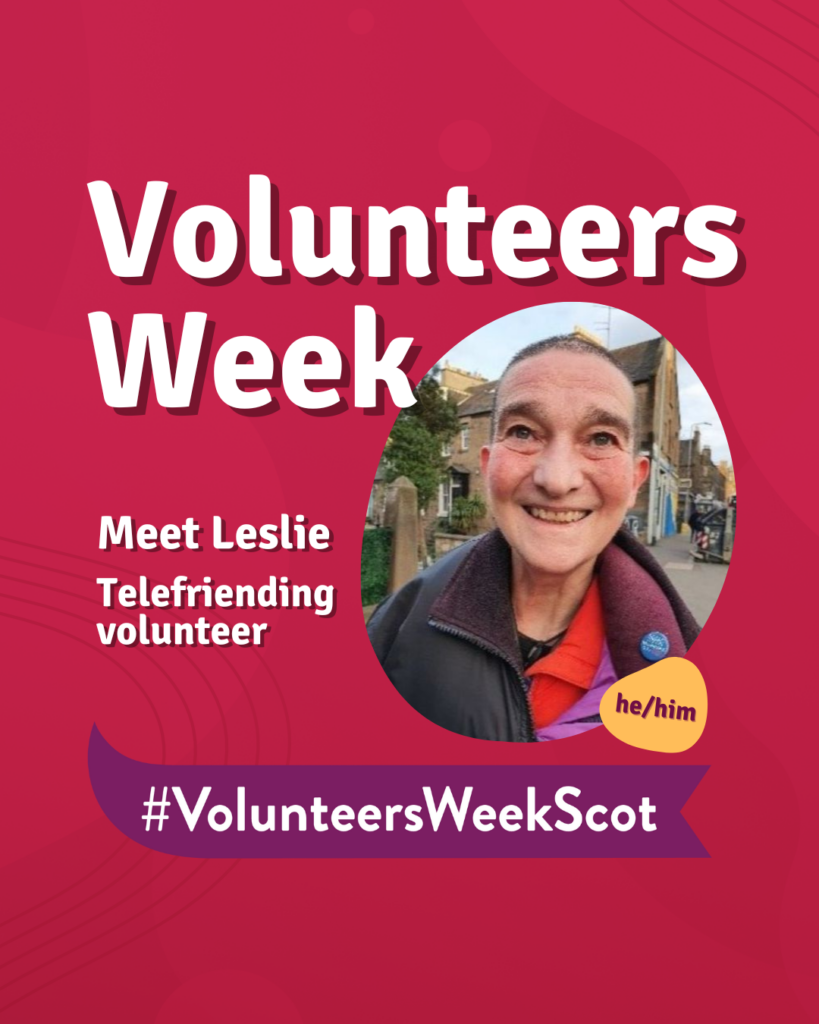
My name is Leslie (he/him)
I volunteer with LGBT Age‘s Telefriending service, which offers free regular phone calls to older LGBT+ people across Scotland.
How did you discover LGBT Health and Wellbeing, and what led you to become a volunteer?
A few years ago, I joined a Transition Support Course and a Men’s Coming Out Course. Both were incredibly helpful. I wanted to give back and contribute to the work of LGBT Health and Wellbeing.
Can you tell us about your role?
As a volunteer Telefriender, I regularly call three gentlemen. I enjoy catching up with them, and our conversations often go on for hours! One gentleman is a treasure trove of LGBT+ history. He has a vast collection of books, magazines, and other materials. Though he’s older, we share many experiences. We’ve visited similar places and met similar people, but I also learn about moments from the past that I didn’t experience myself. Another gentleman I speak with was active in the UK Parliament in the 1950s, advocating for homosexual rights. Speaking with him is also a real privilege.
What makes you proud as a volunteer?
I’m thankful for the opportunity to be part of the Men’s Coming Out Course in 2019. The group was incredibly beneficial to me, and it even led me to make a close friend. As a Telefriender, I’m proud to offer a listening ear and support wonderful people. Everyone I’ve met at LGBT Health and Wellbeing has been so kind.
What do you hope to achieve as a volunteer?
During COVID, many older people have become isolated. Ageism is a significant issue in society, and not everyone feels confident using online services. Thankfully, most people still have access to a phone. I believe offering this small service can help reduce some of that isolation.
What changes would you like to see in the community?
It’s heartbreaking that in over 70 countries, being queer is still illegal. In some places, people can even face the death penalty for their identity. If I could, I’d want the world to wake up and focus on critical issues like climate change, food poverty, the pandemic, and social inequality. I’d like society to stop persecuting people for their identities and who they choose to love.
Do you have a role model or someone who inspires you?
I am deeply inspired by Dr Drew Dalton from the University of Sunderland. He’s involved with Report Out and Hidayah, both organisations that support sexual and gender minorities. Report Out is a global human rights group for sexual and gender minorities, while Hidayah supports LGBTQI Muslims in the UK. These organisations have educated me about the intersection of faith and sexuality.
There’s often a lot of Islamophobia, not just in society, but also among queer people. It’s easy to criticize countries like Saudi Arabia, where LGBT+ people face severe oppression. But if we look at Christianity’s history, especially the Old Testament, we can see that no religion is free from problematic texts. It’s crucial to understand that the real issue lies in the misuse of religion for harmful purposes.
I’m also upset by the homophobia in many African countries, but it’s important to recognise that British colonialism, along with Christian missionaries, played a big role in spreading homophobic views. Hidayah and Report Out work tirelessly to support LGBT+ people in countries where being out is dangerous, and I find their work truly inspiring.